Translate

Wednesday, November 28, 2018

Torture of University of Buea Students: 2 years after

By  
 We pay homage to over 85 students of the University of Buea and several other innocent civilians on and off campus who on 28 November 2018 were tortured by state security officers (police and gendarmerie) as a result of a protest within the main university campus in Buea, South West Region (Cameroon).
The right to education was attacked the moment Dr Nalova Lyonga, then Vice Chancellor, ordered or acquiesced the deployment of at least or about a hundred anti-riot police and gendarmes within the campus to disband peaceful protesters.
On that day, at about 11am, students were chased from the university campus into the streets and were arrested, severely beaten in public and asked to roll in mud.
Following CHRDA’s fact-finding visits to the affected neighborhoods of Malingo tarred, Malingo untarred, Dirty South and UB Junction, we concluded that over 85 students were victims of one or more acts of torture, hundreds of students abandoned their hostels and dropped out of school that year and moved out of the university town for fear of repression; over 14 student hostels having about 140 rooms were all considerably vandalized and rendered uninhabitable by the state security officers who did not only destroy the doors of over 90% of these rooms but did not also hesitate to use tear gas into student rooms, forcing some to open their doors which enabled them loot personal items, brutalized their occupants in their bedrooms and in the streets regardless of their gender.
Soon after this event, about 40 to 60 students, both males and females, were arrested and detained for up to 3 days. Some students who were arrested were asked to pay exorbitant sums of money, usually 50,000 XAF before they were released from detention.
CHRDA reminds the government that this and several other events are the root causes of present-day crises.
CHRDA holds the government accountable for these crimes against university students and civilians which it has never addressed or demanded public excuse for.
CHRDA states that so long as the root causes of present-day crises are not addressed, the hopes for peace, justice and reconciliation to occur are minute.
CHRDA once more pays homage to all university students and civilians who have been tortured since 2016.
CHRDA demands the government to observe and enforce its national and international laws seeking protection of students and civilians and stand by human rights principles.

NB: CHRDA  stands for Centre For Human Rights and Democracy in Africa, Cameroon


Sunday, November 25, 2018

Man of Wigs:Retired Justice Ayah Paul Now Barrister

By Christopher Ambe 
The name Ayah Paul Abine ,in Cameroon in particular and the world in general, is mostly known to revolve around the law: he has been a prosecutor, judge, lawmaker and today he is a barrister. 
In fact, Ayah Paul Abine, now aged 68, also means different things to different people:he is a rights activist, traditional ruler, politician (party leader), dissent, philanthropist, social critic, a caring husband and father.
It was last November 21 in Buea during a court ceremony that this grey-haired legal luminary, several months after his retirement at the age of 67 as Deputy Advocate-General (or Deputy Attorney-General) at Cameroon’s Supreme Court, that he was sworn-in as a lawyer. Retired, but not at all tired!
 In his decades of judicial practice, one of the things that disturbed this legal luminary was/is the fact that the judiciary in Cameroon is not independent as it obtains in advanced democracies. But he distinguished himself and emerged as a magistrate of exceptional class.
Legally speaking, Justice Ayah Paul strongly believes in (and has applied) the principle that “a judge is supposed to be guided by the law and his conscience” in deciding on cases, and also the principle that “Justice must not only be done but seen done!”
Conscious that as a judge the public too judges your objectivity and impartiality in the dispensation of justice, Justice Ayah Paul’s judgments, legal analysts have admitted, were, more often than not, outstanding.
 In so doing, Justice Ayah Paul attracted public accolade but unknowingly stepped on some hierarchical toes that would want things done their way. As such, Ayah  received what some pundits have  described as various forms of torture, which only emboldened him and made him more outspoken in his efforts to right wrongs.
“The law is the law and even the President of the Republic is not above the law,” he likes to say.
 Credited for his high sense of objectivity in adjudication, and after serving as a no-nonsense law maker for a decade, many had hoped Hon.Justice Ayah would be appointed a judge at the Supreme Court of Cameroon, but he was rather appointed Deputy Advocate-General (prosecutor) at same court.
“In the Cameroonian system, you can be on the bench this year and next year you go to the Legal Department. Or, you are in the Legal Department and the next time you are on the bench,” Justice Ayah Paul had told this journalist in an interview in 2015, in reaction to his appointment as Deputy Advocate-General.
But he had insisted: “The point is that wherever you are, you do justice. So, wherever I am I would render justice to everybody without fear or favor. The public can count on me.”
While still serving as Deputy Attorney-General at the Supreme Court of Cameroon, Hon.Justice Ayah was on January 21, 2017 “illegally arrested and jailed without charge” for eight months in Yaounde.” He was only released from detention, along other Anglophone rights activists such as Barrister Felix Agbor Nkongho, by a presidential pardon on August 30, 2017.
In December 2014, Hon.Justice Ayah, who had served as Member of Parliament (MP) for Akwaya for eleven years, became so involved in rights advocacy that members of the (now outlawed)   Southern Cameroons National Council (SCNC) elected him in absentia as National Chairman of the liberation organization, which was created in 1994 to ensure the restoration of independence of British Southern Cameroons.
 But Hon. Justice Ayah, although a noted minority rights crusader, turned down his election on grounds that he was not yet a registered member of SCNC, which at the time was in fractions.
Hon.Justice Ayah, as required by law, was supposed to have been re-integrated into the Ministry of Justice as a career magistrate as soon as his two-term parliamentary mandate ended in September 2013.
In the National Assembly, he had resigned as Chair of the Foreign Affairs Committee to the embarrassment of the ruling party, on whose platform he entered Parliament in 2002.
Hon. Justice Ayah would later be the lone CPDM MP who sharply and openly criticized a 2008 constitutional amendment that removed presidential term limit, which if maintained  would have barred President Paul Biya from standing for re-election in 2011.
This jurist-turned law maker later resigned from the ruling CPDM, convinced that he being “gagged” from effecting positive people-and development-oriented changes within the party, for national interest.
In the National Assembly Hon. Justice Ayah was reportedly  considered within government circles  a thorn in the flesh of the Biya government; but this fearless elite of Akwaya subdivision who loves and speaks the “bitter truth” to power, always argued, and strongly too, that he was working for the interest of the nation, and not for individuals.
 It would be recalled that before Justice Ayah Paul became an MP, he was Vice-President of the Southwest Court of Appeal in Buea.
But even before occupying that position, he had served as President of High Court and Court of First Instance (Magistrate’s Court) in different localities for a total of eighteen (18) years: he was President of Ndian High Court for five years; President of Kumba High Court for two years; he was president of Nkambe Court of First Instance for two years, President of Wum Court of First Instance for two years and President of Buea Court of First Instance for seven years.
  After his parliamentary mandate, Hon.Justice Ayah requested to be re-absorbed into the Ministry of Justice. But for unexplained reasons, he waited for fifteen months-and without a salary, during which time he busied himself, among other things, doing rights advocacy.
But as the SCNC was still pleading with him to accept his election as their chairman, President Biya, coincidentally(some say strategically),signed a decree re-absorbing Hon.Justice Ayah into in the Ministry of Justice with his promotion as Deputy Advocate-General at the Supreme Court.

That did not, in any way, stop Hon.Justice Ayah from writing and educating the public on legal issues and minority rights, especially as he was not only Deputy-Advocate-General at the Supreme Court, but also remained the National President of the political party, Popular Action Party (PAP), whose candidate occupied the fifth position at the 2011 Cameroon’s presidential election. (Justice Ayah himself was the presidential candidate).

With the eruption of the Anglophone crisis in October 2016 over Anglophone minority rights issues, Hon.Justice Ayah, still sitting as Deputy Advocate-General, would be arrested and dumped in detention without being formally charged-a move, which, pundits think, contributed in radicalizing minority rights activists, fighting for the independence of English-speakers in Cameroon.
But political pundits thought that Hon.Justice Ayah’s support for and outspokenness on   minority rights, helped fuel rights protests by Anglophones, who make up 20% of Cameroon’s population of about 24 million.
 Hon.Justice Ayah who put at least 27 years in the judiciary with twenty(20) as magistrate and seven as prosecutor, and eleven as MP before retirement from the Civil Service of Cameroon, has just started a new career as a Lawyer/Barrister, a profession with greater solidarity.

 While in detention as Deputy Advocate-General for eight months only one magistrate reportedly braved the odds to visit Hon Justice Ayah, leaving many to question whether professional solidarity was not cherished by magistrates and or prosecutors.

Ayah  Paul ‘s career started upon his graduation, with flying colors, from the National School of Administration and Magistracy (ENAM) in Yaoundé in 1976.
Many critical observers think that Ayah Paul’s eloquence and mastery of the laws of the land will make him excel in his new career as a barrister.


Friday, November 2, 2018

Cameroon Separatist Leaders Make Court Appearance

FILE - Police forces stand at the entrance of a courthouse in Yaounde, Cameroon, July 16, 2012. Ten Cameroon separatist leaders extradited from Nigeria made their first court appearance in Yaounde Friday.
By Moki Kindzeka
Julius Ayuk Tabe and nine other separatist leaders made their first public appearance Thursday( 1,November 2018)since Nigeria extradited the men to Cameroon in January.

The men appeared tired as they were brought into a Court of Appeals in the capital under heavy military escort.

Nigerian authorities arrested Tabe and 46 of his followers in Abuja, where they were accused of remotely leading a rebellion in English-speaking parts of Cameroon.

The 36 others who did not appear in court have yet to be seen in public.

Separatist supporter Diana Awemo said she traveled from the English-speaking northwestern town of Bamenda to see the men.

"We are happy. We can now confirm that ten of them are alive. We want to see the others that were kidnapped with them in Nigeria and brought back into Cameroon." Awemo said.

Defense counsel John Nsoh said the accused were deprived of their right to meet their lawyers. He said they have filed a motion for their immediate release.

"This is the first opportunity for them to tell their story to a court. These people were arrested illegally, they were abducted, they were not even arrested, taken from a foreign country and brought into Cameroon and detained incommunicado for more than 10 months," Nsoh said.

Cameroon’s government calls the separatist leaders terrorists and says those arrested will go before a military tribunal. If convicted, they could face the death penalty.
Tabe in October last year declared himself the president of what he called the English-speaking republic of Ambazonia in Cameroon’s northwest and southwest.

Since Tabe’s arrest, armed separatists have launched sporadic attacks in the region on the military, markets and public buildings. At least a hundred schools have been torched and 300,000 people have fled to safer, French-speaking towns and neighboring Nigeria.

The government says more than 400 civilians, police and troops have been killed in the fighting.

In spite of the tensions and violence, Emmanuel Ngaibe, a relative of one of the arrested separatist leaders, expressed hope they will receive a fair trial.

"I hope that the court will be very, very independent and exercise justice and that politicians will not intervene in the matter," Ngaibe said.

Violence erupted in Cameroon’s English-speaking regions in 2016 when teachers and lawyers protested alleged discrimination at the hands of the French-speaking majority.

The government responded with a crackdown that sparked a movement for an independent, English-speaking state.
-VOA News

Sunday, October 28, 2018

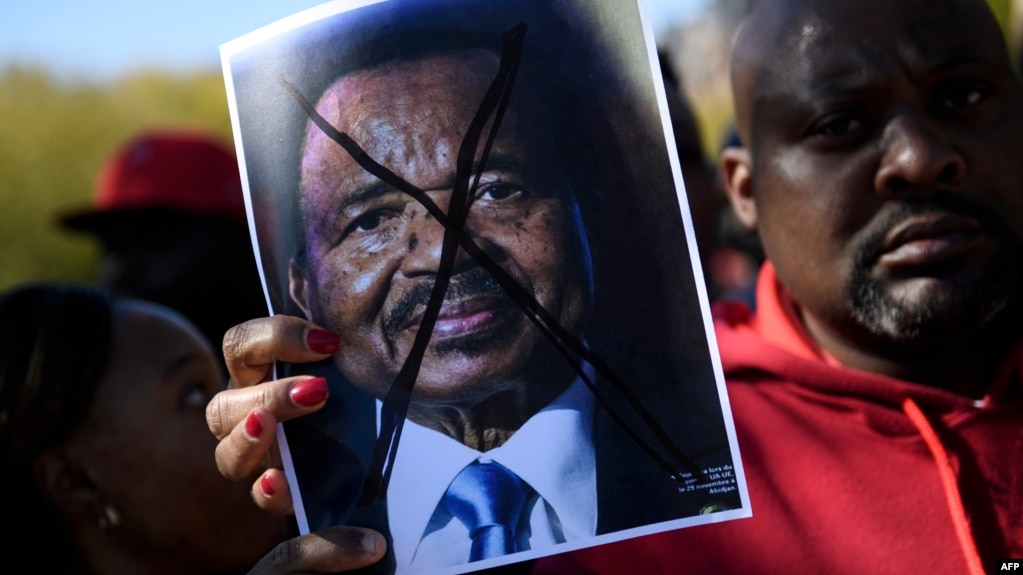
Cameroon Protesters Demand Biya Step Down

People protest Cameroon's President Paul Biya on Pennsylvania Avenue near the White House, Oct. 22, 2018 in Washington. On Saturday protesters marched and sang on the streets in Douala and other cities
Hundreds of people, most of them youths, Saturday marched and sang in the streets of Cameroon’s economic capital city, Douala, calling for Cameroon President Paul Biya to step down immediately.

Bosco Etoundi, a 23-year-old university graduate, says protesters believe Maurice Kamto, of the Cameroon Renaissance Movement political party, who ran against Paul Biya in Cameroon’s Oct. 7 presidential election actually won. Kamto was declared runner-up, with 14 percent of the votes.

Etoundi says he wants Kamto to immediately take power because he is tired of having a president who does not provide for residents’ needs.

Etoundi says young people make up more than 70 percent of Cameroon’s population, but Biya has never involved the younger generation in decision-making. He says that after students complete their studies, they remain jobless because Biya is not creating jobs. He says a change is needed.
Maurice Kamto, a presidential candidate of Renaissance Movement (MRC), reacts as he holds a news conference at his headquarter in Yaounde, Cameroon, Oct. 8, 2018.
Protesters arrested
Cameroon police reported the arrests of more than two dozen protesters Saturday. Witnesses say some protesters were beaten and dragged through the mud.
However, Kamto’s Cameroon Renaissance Movement said 42 people, including some of its party officials, have been arrested and are being detained.

Among those arrested is Michele Ndoki, a lawyer who defended Kamto at the constitutional council, where they alleged massive fraud and ballot-stuffing in favor of Biya’s ruling Cameroon People’s Democratic Movement (CPDM) party.

The constitutional council rejected Kamto’s petition and Kamto, who had earlier claimed victory, announced what he called a national resistance program in regard to Biya’s inauguration ceremony in December, although no date has yet been chosen.

Ivaha Diboua, governor of the littoral region of Cameroon where Douala is located, says he will never tolerate any disorder in his administrative area and anyone who creates disorder will face police action.

Diboua says Cameroon respects people’s freedoms, but that no one should abuse the freedom by denigrating, insulting and stigmatizing others claiming that they felt cheated.
Besides Douala, minor protests were reported in the cities of Yaounde and Bafoussam but were quickly contained by police.

36 years of Biya
Biya, who has been in power for 36 years, was declared the winner of the Oct. 7 presidential poll, winning 71 percent of the vote. His runner-up, Kamto, who won 14 percent of the vote, has rejected the results.

In 2008, Biya removed term limits from the constitution, allowing him to serve indefinitely.
He is now the second-oldest president in sub-Saharan Africa. When his new term is finished, he will be 93 years old.

Kamto’s MRC party has vowed to continue with the protests until Biya steps down. In a statement Saturday, Kamto called for police to release those who have been arrested, stating that they were simply expressing their discontent at the election.
-VOA Africa


Friday, October 19, 2018

Cameroon court rejects all petitions calling for re-run of elections

YAOUNDE (Reuters) - Cameroon’s Constitutional Council on Friday rejected the last of 18 petitions calling for a re-run of an Oct. 7 election that the opposition said was marred by fraud, paving the way for results expected to extend President Paul Biya’s 36-year rule.

The rejections clear all legal objections to the polls. Nearly two weeks after the vote, no results have been announced but under national law authorities have until Monday [October 22] to do so.

Biya is seeking a seventh term that would see him keep his place as one of Africa’s longest-serving leaders. The only current African president to have ruled longer is Equatorial Guinea’s Teodoro Obiang Nguema Mbasogo.

But allegations of voter intimidation, violence and ballot-stuffing cast doubt over the election, prompting the three main opposition candidates, and other prominent political figures, to call for the cancellation of results.

“We reject in totality the results” of the elections, said Paul Eric Kingue, the campaign manager for opposition candidate Maurice Kamto, whose call for a re-run of the poll in seven regions was rejected late on Thursday. “Paul Biya is not our president.”

Candidates Joshua Osih and Cabral Libii asked for the results to be cancelled and the election to be re-run. The court rejected Libii’s appeal late on Tuesday because it said it was filed one hour after the deadline.

Osih’s appeal was rejected in the early hours of Friday morning.
“We as Cameroonians should be ashamed of what is currently happening in front of this high jurisdiction we call the Constitutional Council,” Nkou Mvondo Prosper, President of Libii’s Univers party said.

The elections went ahead with scattered instances of violence in the Anglophone South West and North West regions where a separatist insurgency is trying to split from Yaounde. In those regions, which hold about a quarter of the country’s 24 million population, most did not vote for fear of violence

Thursday, October 18, 2018

Cameroon opposition leader's home torched, court told


© Provided by AFP Cameroon's Ni John Fru Ndi has spent the past quarter of a century in opposition as head of the SDF which he founded in 1990 although he stood aside for this month's election
Anglophone separatists have torched the home of Cameroon's veteran opposition leader and kidnapped his sister, his lawyers said on Thursday. 

The two incidents, which took place Wednesday, targeted Ni John Fru Ndi who heads the Social Democratic Front and comes from Cameroon's troubled anglophone west.

Separatists "burnt (Fru Ndi's) house" in the North-West, said lawyer Francis Sama, referring to one of Cameroon's two English-speaking regions which have been hit by almost daily unrest that has left at least 400 dead this year.
"They kidnapped his younger sister," he said at a hearing before the Constitutional Court, without giving further detail on either incident

His remarks were made during a hearing at which three opposition candidates asked for the contested October 7 presidential election be annulled on grounds of massive fraud.

Fru Ndi has spent the past quarter of a century in opposition as head of SDF which he founded in 1990. 

But although he ran for the presidency three times, Fru Ndi stood aside this time, letting his deputy Joshua Osih join the race against President Paul Biya who has ruled Cameroon for 36 years. 

Although Fru Ndi has long opposed Biya's rule, the separatists see him as a "traitor" because he is in favour of returning to a federalist solution in Cameroon, while they are fighting for the creation of an independent anglophone state, Sama said.
Yaounde is firmly opposed to any return to federalism.

Cancel the vote

Separatist activists had called for a boycott of the election, but SDF decided to run
In a separate incident, the SDF said Fru Ndi's driver had been shot at by the security forces after dropping the party leader home at the weekend. Without giving further details, they said he was "out of danger".

The political crisis in the English-speaking west of this Francophone country erupted in 2016 and deteriorated into an armed separatist uprising last year which prompted a retaliatory crackdown by the security forces.

Following the election, SDF's Osih asked the court to scrap the ballot because "there was no presidential election" in the English-speaking regions where voting was disrupted and turnout was below five percent, the ICG think tank said. 

Two other opposition candidates also joined the petition -- Maurice Kamto of the Movement for the Rebirth of Cameroon and Cabral Libii, a TV news analyst and at 38, the election's youngest candidate.

Libii's request was dismissed as inadmissible, but the court has yet to respond to the other two petitions.
Courtesy:AFP

Tuesday, October 9, 2018

Cameroon minister calls opposition win claim 'non-event'


Sunday's vote was marked by violence in restive anglophone regions as well as low turnout and difficulties staging the ballot in the conflict-torn areas (AFP Photo/ALEXIS HUGUET)
Yaoundé (AFP) - Cameroon's Interior Minister Paul Atanga Nji warned Tuesday that "scoring a goal" is not "winning the match" after an opposition leader used a football metaphor to claim victory in presidential polls.

Maurice Kamto, candidate of the Movement for the Rebirth of Cameroon (MRC) party, said Monday he "was charged with taking a penalty, I took it, and I scored", proclaiming himself victor of weekend polls.

He gave no evidence for his claim.
Sunday's vote, in which Kamto headed a partial opposition coalition, was marred by violence in restive anglophone regions as well as low turnout and difficulties staging the ballot in the conflict-torn areas.

"Even if you score a penalty, you don't necessarily win the match at the end," Atanga Nji told AFP, adding that Kamto's announcement was a "non-event".

By law each polling station must submit its results, after verification by the Elecam electoral commission, to the Constitutional Court which is responsible for announcing the official final tally within 15 days of the vote.

But a raft of unofficial results from Cameroon's nearly 25,000 polling stations have already begun to circulate on social media.

Ahead of the polls in which 85-year-old President Paul Biya sought a seventh term, Kamto warned he would not accept any result tainted by fraud.

The government has called Kamto an "outlaw" for announcing his own result.
"I have received a clear mandate from the people and I intend to defend it until the end," he said at a media briefing in Yaounde on Monday.

But Atanga Nji accused Kamto of creating "an unacceptable mess".
"He says he'll go all the way, but he won't even have time to get going... and no one will follow him," Atanga Nji said.

The candidate of the main opposition Social Democratic Front (SDF) party, Joshua Osih, said Monday it was "a bit premature to be giving results" and called on his seven fellow candidates to "respect the law".

The youngest of the nine candidates, 38-year-old jurist and journalist Cabral Libii of the opposition Univers party, warned against election fraud.

"If our victory is established, I will by no means allow it to be stolen by anyone," the social media-savvy candidate told reporters on Tuesday.

The US embassy in Yaounde meanwhile called "on all parties to wait until the official results are announced before making pronouncements about the supposed winner," in a post on its verified Facebook account.

Kamto, a former junior justice minister, was backed by rival candidate Akere Muna just before polling day, creating the first opposition electoral union since 1992.

Thursday, October 4, 2018

CHRDA Condemns Recent Extrajudicial Executions in Buea-Cameroon


 Find below a statement from the Center for Human Rights & Democracy in Africa(CHRDA) released today:

THE EXTRAJUDICIAL EXECUTIONS AT CAMPAIGN STREET 2, GREAT SOPPO BUEA ON MONDAY THE 24TH OF SEPTEMBER 2018 AND THE 27TH SEPTEMBER 2018 MASSACRE AT BUEA TOWN.
On Monday the 24th day of the month of September 2018, the military forces (BIRS) shot and killed two young men at Great Soppo, situated in Buea, capital of the South West Region. This incidence occurred in the early hours of the morning at about 9am to 10am.
In an interview conducted by CHRDA Human Rights Monitoring and Reporting team, an eye witness recounted that one of the victims, Mr. Emmanuel Ndasi Ndum Forton, born 13th December 1979. He was a taxi driver who lived at Campaign Street 2, he left his house to the main road to empty a water reservoir tank at the ‘Car Wash Point’ owned by his elder brother. The elder brother had been warned by the Buea Municipal Council to remove the tank from the spot stating that it was obscuring a clear view of the poster of the CPDM candidate for presidential election Mr. Paul Biya. As he went out and open the tank for the water to pour out for an easy removal, he then returned to the house to keep the cock of the reservoir and to invite his friends to come and assist him pull the reservoir away.
From there, he was now going back to the site of the reservoir before he met his friend Mr. Ndam Ngoh Emmanuel, born 19th April 1990, a taxi driver who resided in the same quarter and invited him to assist him push the reservoir away. Both of them were putting on bathroom slippers and as they were still standing at the spot, a military truck on patrol, carrying BIR soldiers and driving down from Buea town apprehended them on the suspicion that they look like Ambazonia soldiers and shot them both at the spot. Immediately after the killing, the soldiers disappeared from the scene leaving the victims by the road side.
It should be recalled that the extrajudicial execution of these two young men at Great Soppo in Buea, follows a series of widespread and systematic killings perpetrated by the Defence and Security forces against unarmed Civilians in the city of Buea. A classic case in point was that which occurred on Monday the 30th day of July 2018 where four young men, to wit: Esembe Roland Ndobe, Mononno Emmanuel, Motombi Maya Woleta and Tambufor Eric where rounded up and shot dead by the BIR at Bakweri town under the pretext that they were caught smoking weed. Note should be taken that these killings are carried mostly on Mondays; a day widely observed as ghost town in the two English speaking regions of Cameroon. 
Another case of extrajudicial killing in Buea occurred on Sunday the 26th of August 2018, wherein, the elements of the Defense and Security Forces (BIR) shot and killed a young man at Check Point, just in front of the Molyko Municipal Stadium called Nzometia Theophile. It is alleged that he was shot on grounds that he was dressed like a soldier of the Ambazonia Restoration Forces.
Extrajudicial executions on Monday the 24th of September were also recorded at Ekona, a locality in the Muyuka Sub Division, Fako Division of the South West Region. In this locality, two young men were rounded up in a military expedition and shot death. From the testimony of residents of Ekona talking to CHRDA, the military forces raided the area at about 9am in the morning, in a search for members of the non-state forces, an as they were conducting the search, gun shots were being fired sporadically and causing panic on the local population. As the gun firing continued, some two unarmed young men got scared and attempted to flee but were spotted by the military and shot at close range from behind as they tried running into the bush.

27TH SEPTEMBER 2018 MASSACRE IN BUEA TOWN.
On Thursday the 27th day of September 2018, the military forces (BIR) targeted and killed 7 identified unarmed civilians in a compound at Ikundi Street in Babuti neighbourhood of the town of Buea, South West Region of Cameroon. This incidence occurred at about 4:30 AM where the military conducted a raid at the compound and 7 unarmed civilians were extrajudicially executed in the raid.

The Centre for Human Rights and Democracy in Africa visited the scene of the incidence in the early hours of the morning before the corpses were carried away, and interviewed some persons who prefer to remain anonymous, and they testified that the compound in which the incidence took place has been under military surveillance for quite a while, after the soldiers were alerted by an unidentified person that a particular individual (one of the victims) was dealing in hard drugs such as Marijuana and contraband drugs like tramadol which many young men including some gendarme officers come to buy and even consume it at his room. Aware of this, the soldiers had already targeted the compound with intent to capture the dealers.
The witnesses stated further that when the military arrived at the scene, they broke into all the doors in the compound and brought out about 6 young men from one room and a 50 years old man, one of the tenants from another room and executed them. One of the victims escaped with bullet wounds but died later at the Buea Regional Hospital. The names of the 7 victims were identified as:
1:        Alain Kumeta
2:        Bobga Francis
3:         Toh Nduko Moses (50 years)
4:        Enow Eric
5:        Ramadan
6:        Mesumbe and
7:        Batino

SEARCH THIS SITE