Translate

Friday, March 15, 2019

Cameroon: Government revokes suspension of beer price hike

Cameroon: Government revokes suspension of beer price hike
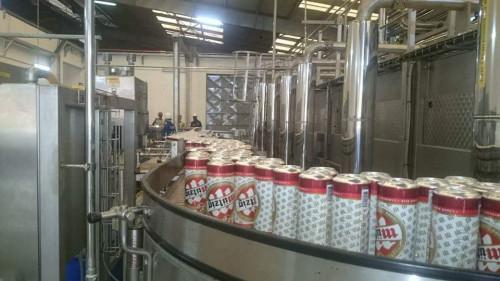
(Business in Cameroon) - After it suspended it a few days ago, the Cameroonian government has finally approved the XAF50 increase in drink prices initially decided by brewing companies Sabc and Guinness, notably.

According to the trade department, these companies along with consumer rights associations and the trade unions of drink outlets’ operators met the trade minister, Luc Magloire Mbarga Atangana, on March 12 in Yaoundé, to discuss price scales suggested by the industry ; this in accordance with provisions of the 2019 Finance Act.

“At the end of the work, these scales were validated and thus the introduction of an increase ranging from XAF0 to XAF50 maximum per bottle,” informs the ministry.

New scales will be displayed in all outlets all over the national territory. Prices increased by XAF100 will now be increased by only XAF50.

Let’s note that the brewing companies explained that this price increase follows an augmentation by 5.5% in excise duties, concerning alcoholic beers.
Sylvain Andzongo

Monday, March 11, 2019

Former defence minister charged with corruption in Cameroon

Former defense minister Edgar Alain Mebe Ngo'o. 

By Staff Sergeant Michelle Gonzale
Former defence minister Edgar Alain Mebe Ngo'o, once tipped to succeed Cameroon President Paul Biya, has been charged with diverting public funds and corruption.
 "Mr Mebe Ngo'o is suspected of diverting public money and corruption," an official of the Special Criminal Tribunal told the French news agency, AFP.
 Mebe Ngo'o was put in provisional detention on Friday and sent to the central prison in the capital Yaounde, the official added.
 "He was locked up along with the deputy director of a bank, a Treasury inspector and an army colonel," he said.
  A fifth person was still being questioned in the same investigation.
The former minister was summoned Tuesday to the tribunal, which deals with major corruption cases, and detained.
 Mebe Ngo'o was sacked from the government last year where he served from 2015 as transport minister after spending the six previous years at defence.
Cameroonian journalist Jules Koum Koum, who died in a road accident, had in 2010 investigated an alleged over-billing scandal for military uniforms at the defence ministry when Mebe Ngo'o was minister.
Before joining the government, he had led the police force and run the presidency's civil office.
Source:RFI


Thursday, March 7, 2019

Cameroon opposition leader's detention 'not political': government


Kamto was runner-up to incumbent President Paul Biya in an October election, a result he disputes.

Kamto was runner-up to incumbent President Paul Biya in an October election, a result he disputes (AFP Photo/Reinnier KAZE)

Yaoundé (AFP) - Cameroon has rejected US criticism of the detention since January of opposition leader Maurice Kamto, insisting that it was not politically motivated.
Kamto and more than 150 supporters are being held for "common law" offences, Communications Minister Rene Emmanuel Sadi said in a statement Tuesday, citing "insurrection, hostility to the homeland (and) rebellion".
The detainees are also accused of destroying public property, both within the central African country and at several Cameroon embassies abroad, the statement added.
A military court charged them in mid-February.
Tuesday's statement was in response to comments Monday by Tibor Nagy, the US assistant secretary of state for African affairs.
Nagy told Radio France Internationale that Cameroon would be "very wise" to release Kamto because his detention is widely perceived as politically motivated, despite the government's claims to the contrary.
Sadi said Nagy's remarks revealed a poor grasp of the facts and amounted to "barely veiled" and "unacceptable" interference in Cameroon's internal affairs.
Nagy is due in Cameroon on March 17 and 18.
Kamto, president of the opposition Movement for the Rebirth of Cameroon (MRC), came second to President Paul Biya in last October's presidential election.
He says he was cheated out of the presidency when Biya, 86, was elected to a seventh term.
Police arrested him and around 150 of his supporters on January 26 after peaceful demonstrations in several cities across the country.
On the same day, Cameroonians living abroad hostile to the Yaounde government attacked the country's embassies in France and Germany, causing some damage.
The government statement said the demonstrations in Cameroon were illegal and blamed Kamto's supporters for the damage to the embassies. Kamto has denied any responsibility.
On Tuesday, the European Union added its voice to criticism of Cameroon's treatment of the opposition activists.
EU foreign policy chief Federica Mogherini criticised the arrests and what she called the military court's "disproportionate" proceedings against them.
"Hostility to the homeland" is punishable by death in theory, though no one has been executed in Cameroon for more than 30 years.
Mogherini also lamented the "deterioration of the political and security situation in Cameroon".


Wednesday, March 6, 2019

Cameroon:Running for safety amidst Anglophone Crisis

By   Peter Ndange 
The Anglophone crisis, which has registered thousands of deaths as a result of confrontations between Government forces and armed separatists fighting for the independence of English-speaking Cameroonians (Anglophones), has kept citizens living in uncertainty and fear.
Both Government forces and separatist fighters have been accused by rights groups of burning down public and private property, worth hundreds of millions of Fcfa, leaving victims desperate and homeless.
According to an investigative report by the Centre for Human Rights and Democracy in Africa(CHRDA) published in August 2018, “one hundred and seventy six villages(176) both in the North West and the South West Regions of Cameroon have been raided and partially or severely burned down by state defense forces in an attempt to crackdown on armed separatists .’’   .
Maria Atongajua in search of safety

 A recent case of arson is that of Maria Atongajua, whose family residence was reportedly burnt in Lebialem Division of Southwest Region forcing family members to run into hiding for safety.
Lebialem is a stronghold of separatist’s fighters with the dreaded warrior called General Ivo. What is very pathetic about the nearly 32 year-old Atongajua’s case is that she is an orphan.The burnt residence is said to have been the only property her parents left for her. Many other arson victims in separatist strongholds such as Muyuka have frightening experiences to share on how they became homeless.
CHRDA, in the aforementioned  report, warned: “This act of burning villages is in breach of classical common article 3 to the Four Geneva Convention 1949 and the Additional Protocol II to the same Convention dealing with the non-international conflicts
“Also, the burning of villages and destruction of civilian property is in breach of national and international human rights norms and the host of other laws. 
“These crimes and acts are to be thoroughly investigated and perpetrators brought before the competent authorities”
The mass media and social media are awash with images of burnt property and sometimes those of charred bodies of people burnt alive in their houses in villages.
Part of Kumba Hospital burnt down
 Only last February 11, the Kumba District Hospital  was burnt down.
Reports claim the Cameroon military burn down houses and villages which they suspect serve as hideouts for secessionist fighters but the military has refuted the allegations, shifting the blame to separatists.  Separatists too are alleged to be burning down public structures such as schools and vehicles.

Many victims of burnt houses are now living in bushes while others fled to foreign countries for asylum, to avoid further persecution.
According to the UN , about a million people are internally displaced due to the ongoing Anglophone Crisis, while over thirty thousand people are seeking asylum in neighboring Nigeria.
The crisis has given rise to a serious humanitarian crisis in Cameroon needing huge global support, according to the UNO and rights groups.
As the crisis worsens, Anglophones in the Diaspora have staged many protest marches at Cameroon embassies against the Biya regime and have called on the government to engage in genuine and inclusive dialogue but the Government appears reluctant and has instead called on the separatists to lay down their arms or be crushed.
The Cameroon has accused separatist fighters in the Diaspora of sponsoring the independence of Anglophones, insisting that Cameroon remains “one and indivisible”
Many Anglophone rights activists in the Diaspora such as Mark Barata,Cho Ayaba,Tapang Ivo,Akwanga Ebenezar,Chris Anu, Akoson Pauline, John Mbah Akuroh and Akoson Raymond are wanted by the state of Cameroon.
The Anglophone Crisis erupted in 2016 when common law lawyers and Anglophone teachers’ trade unions staged protests pressing for solutions to their professional grievances but the Cameroon government resorted to repression.

Anglophone Crisis and the price paid by independence activists


By Tabe H. Clinton 

The on-going Anglophone crisis started as Common Law lawyers’ and Anglophone teachers’ protests, pressing for improved work conditions in late 2016.

 But it suddenly morphed into a campaign for the independence of the minority English speaking Cameroonians, many of whom complained of marginalization by the majority French-speakers.  Their fight is to have their independent country which they have named as Federal Republic of Ambazonia.

English speakers (Anglophones) ,who constitute today’s  Southwest and Northwest regions of Cameroon,  were  formerly a UN-British trust territory, called Southern Cameroons, and later gained its independence on October 1,1961 by joining  La Republique du Cameroun.

 Cameroon’s 20% of its population of about 24 million are English speakers and 80% French-speakers.

As protests for the independence of Anglophones continued and intensified, Cameroon government on January 17, 2017, banned the Southern Cameroons National Council (SCNC), which had been formed in 1994 to ensure the statehood of Anglophones .The Government also banned the Barrister Felix Agbor Nkongho-led Cameroon Anglophone Civil Society Consortium (CACSC) which coordinated the wide-spread anti-government protests.

The  ban, signed by then Minister of Territorial Administration, René Sadi, stated: “The groups Southern Cameroons National Council (SCNC) and the Cameroon Anglophone Civil Society Consortium (CACSC) are declared null and void for their purpose and activities, which are contrary to the Constitution and liable to jeopardize the security of the state, territorial integrity, national unity and national integration.”

But as protests continued Cameroon defense and security forces brutally confronted the protesters and hunted SCNC adherents, resulting in a situation even innocent Anglophones were victimized by either by the military or the combatants. 

The birth of armed separatist fighters was because the military raided neighborhoods, killing agitators -suspected to be separatists, and burning down homes thought to be hide-outs for combatants. Citizens were by the ugly circumstances   to flee, in their hundreds, into the bushes for safety. 

Since then armed separatist groups have been engaging in bloody and deadly clashes with the government forces. 

When on September 22, 2017 President Paul Biya was addressing the United Nations in the USA, anti- Biya protests by Anglophones took place across towns and cities in Anglophone Cameroon, as well as   in front of Cameroon embassies in Europe, South Africa and at the UNO. 

In Bamenda, considered as the opposition city of Cameroon, the protest marches were very massive and led to bloody confrontation between protesters and security forces.
 Many protesters such as Muteminui Charles Afah, one of the mobilisers, were tortured, arrested and detained. 
Muteminui Charles Afah
Then on   October 1, 2017 Sisiku Julius Ayuk, President of the Ambazonian Interim Government, made a symbolic declaration of the Independence of Southern Cameroons as Anglophones in their numbers  organized peaceful marches in various localities singing freedom songs.

That declaration of the independence of Anglophones, which was greeted by street demonstrations, forced the Biya government to intensify its military crackdown on separatists. 

Again many suspected activists and separatists were tortured, arrested and reportedly killed during   independence protests in Northwest and Southwest Regions. People died in mysterious circumstance and several civilians were declared missing. 

The mysterious death of the parents of Muteminui Charles Afah, was   linked to their involvement in SCNC and the incident terribly frightened him.

Although an SCNC adherent,  Muteminui Charles Afah was suspected by Ambazonian fighters as a traitor leaking information to the military about their hideouts, an accusation which he debunked. Family sources said he later went into hiding, realizing that he was targeted both Security forces and Ambazonian fighters. 

It is public knowledge that hundreds of people have died as government forces and separatist fighters continue to engage in violent clashes. Property worth billions of Fcfa has been vandalized; over 30 thousand Cameroonians are seeking asylum in Nigeria, while over 300 thousand people have been internally displaced.

Many activists have been prosecuted and jailed for secession/terrorism-related crimes.
Many independence activists fearing for their lives have fled Cameroon. 

But Anglophone rights activists in the Diaspora such as Chris Anu, Mark Barata,Cho Ayaba,Tapang Ivo,Akwanga Ebenezar, John Mbah Akuroh and Eric Tataw continue to instigate for the  fight for Anglophone independence.


Monday, March 4, 2019

Nigeria court says extradition of Cameroon separatists 'illegal'

The crisis in Cameroon's anglophone western regions has claimed the lives of at least 500 civilians and more than 200 police and soldiers, the International Crisis Group says (AFP Photo/MARCO LONGARI)
Lagos (AFP) - A Nigerian court has condemned as "illegal and unconstitutional" the arrest and deportation of Cameroonian separatists who had applied for asylum in Nigeria, their lawyers said Sunday.
In January 2018, Nigeria arrested and sent back 47 anglophone separatists who had fled Cameroon following a crackdown by the authorities.
The move was denounced by UNHCR, the UN refugee agency, which said most of them had filed asylum claims. It accused Nigeria of breaching international agreements.
"Justice Chikere declared the arrest and detention of the 12 applicants illegal," said a statement from Nigerian law firm Falana & Falana, referring to a ruling issued last week in the capital Abuja.
"Consequently, Justice Chikere declared the deportation of the applicants illegal and unconstitutional, awarded (compensation) to each of them and ordered the federal government to ensure that they are brought back to Nigeria forthwith."
Among the 12 Cameroonian claimants in this case was separatist leader Julius Sisiku Ayuk Tabe, president of the self-declared "Republic of Ambazonia". He and his supporters were among those arrested by Nigerian intelligence agents on January 9, 2018.
Nigerian officials sent the group back to Cameroon a few weeks later on January 26.
For months, the 47 have been held in isolation at a high-security facility at police headquarters in Yaounde, Cameroon's capital.
In December, a military court in Yaounde opened a trial against Ayuk Tabe and nine others for "terrorism" and "secession".
Just before the start of that trial, Ayuk Tabe was transferred to a lower security prison in the capital where he can receive visits.
The next hearing is scheduled for March 7. Defence lawyers have already argued before the court that the defendants should be returned to Nigeria.
During last week's hearing in Abuja, defence lawyer Femi Fakana had argued that the arrest and detention of refugees and asylum seekers constituted a breach of Nigeria's constitution and the African Charter on Human and Peoples' Rights.
The judge agreed, saying the expulsion of the group was in "utter violation" of legal obligations which ban Nigeria "from expelling or deporting refugees" from the country.
He ordered the government to ensure they were brought back to Nigeria, and that their fundamental rights were respected.
Mark Bareta, one of the leading advocates of the anglophone separatist cause, welcomed the Nigerian court ruling.
English-speaking Cameroonians "are happy that at least in Nigeria there is an independent judiciary," he wrote on his Facebook page, which has more than 100,000 followers.
They were hoping that the Nigerian government would respect this legal ruling, he added.
Clashes between the armed forces and separatists take place almost daily in the two Anglophone regions on the western flank of Cameroon.
Resentment there at perceived marginalisation by the French-speaking majority boiled over into an armed uprising in late 2016, prompting a harsh government crackdown.
Courtesy:AFP

Monday, February 25, 2019

2019 Mt Cameroon Race of Hope: Peace-plant-carrying athlete steals show !


Mt Cameroon race athlete, Jules Nkomnkom, with peace plant calling for the return of peace to Cameroon,whose two English-speaking regions  have not known peace since 2016,with the eruption of the Anglophone  Crisis; Photo Credit: Chris Ambe


By Christopher Ambe 
The 24th  edition of  Mount Cameroon Race of Hope, last Saturday February 23th , took place  in Buea, amid very tight security intended to counter threats of life by separatists who did not want  the event  come to fruition, and had called for ghost towns in Fako Division, to disrupt it.
Even as 36-year old Mbatcha Eric and Tatah Carine emerged as the 2019 champions in the senior male and female categories respectively, another athlete, Jules Nkomnkom shot into prominence by introducing a new initiative of peace advocacy.  

Although not a race winner, Nkomnkom, who almost entirely covered his race t-shirt with the Cameroon flag and was carrying a peace plant, became a center of attraction as he returned from the mountain. As he arrived at the Molyko Omni sport Stadium, the plant-carrying athlete excitedly knelt on the finish line, raised his plant and prayed to God for a quick return of peace to Cameroon.
Nkomnkom’s initiative- at this critical moment with the ongoing Anglophone Crisis was greeted by cheers from the crowd, prompting the Minister of Sports and Physical Education, Professor Narcisse Mouelle Kombi, to improvise a special prize of 200,000fcfa for the athlete, which award was baptised the “citizenship and patriotism prize.”
 Apparently because of the secessionists’ threats, only 241 of the initially registered 522 athletes courageously took part in the race in the senior, veteran, minor and relay categories. 
This year, thousands of frightened people  who -everything being equal ,would have jammed the Molyko Omnisport stadium to watch the athletes cross the winning line  rather stayed indoors, preferring to watch the race on TV in the comfort and safety of their homes.
Mbatcha Eric, 36, who emerged this year’s winner in senior male category covered the race’s 38 km in 4h40m and received a cash prize of 10 million Fcfa.
In the women’s category, last year’s winner Tatah Carine  still emerged in the first position, doing the race in 5h 29m and smiled home with a cash prize of 10mFcfa as well.
 Just a few foreign athletes ran this year and none emerged as a winner, unlike last year when a Kenyan, Chelimo Luka kipkemoi, emerged third in the male category and became the first foreigner to emerge among the winners in the Race of Hope’s 23 editions.
Originally, Mt Cameroon race started in 1973, and was only christened as Mt Cameroon Race of Hope in 1996, when the main sponsor Guinness SA withdrew.
Other 2019 winners
In the male category (Senior) Ali Mohammadou, from Bui Division of the  Northwest region, emerged second, doing the race in 4h44m and received a cash prize of seven million Fcfa, while Gabsibuim Godlove, who  was champion last year, came third, bagging home five million Fcfa.
In the female category (senior), Ngalim Lizette who secured the second place, smiled home with seven million Fcfa. The third winner was Ngwaya Yvonne, with a cash prize of Five million.
Other winners and runner-ups received additional prizes from co-sponsors of the race, which was organized by the Cameroon Athletic Federation with support from the Cameroon government.
 Professor Narcisse Mouelle Kombi, Minister of Sport and Physical Education and Motomby Mbome Emmanuel, President of Cameroon Athletic Federation, co-chaired both the launching ceremony of the race on Friday February 22 and the race, whose course distance of 38km starts from the Molyko stadium to the Summit of Mount Cameroon(towering about 4090m above sea level) and back.
Cameroon's Sports Minister,Narcisse  Mouelle Kombi (middle) with  2019 Mt Cameroon race champions (male senior category)
Launching the race, Prof.Kombi, who was doing it for the first time since becoming Sports Minister noted, “Sport competition always contributes to the spirit of working together.”
Southwest Governor, Bernard Okala Bilai who was chair of the race’s Local organizing Committee, received accolade from the sports minister and the Cameroon Athletic Federation, for his sustained efforts towards the   success of event.
The race was also marked by side events like musical concerts and cultural dances at the Molyko Omni sport Stadium.
When the race started in 1973, John Ekema emerged pioneer champion and did the course, which was at least 8km shorter then (the starting and finishing point was Buea Town and not Molyko)  in 5h47’

Monday, February 18, 2019

Roundup: 170 students kidnapped in restive Anglophone region of Cameroon released

YAOUNDE, Feb. 18 (Xinhua) -- One hundred and 70 students and their teacher in a restive English-speaking region of Cameroon were released Sunday, two days after their abduction by gunmen, according to school authorities.
"They took away 170 students, two college security guards, one teacher and three of his kids. The abductees were released sometime in the afternoon of Sunday 17 February 2019," Elvis Nsaikila, Kumbo diocesan director of communications, said in a statement.
The statement added that shortly after their release, the abductees assembled in a mission station where they were conveyed by authorities back to the college campus in the evening.
The abducted students and their teacher are from St. Augustine's College, a Catholic secondary school in Kumbo, a town in Northwest, one of the two war-torn English-speaking regions of Cameroon. School authorities said they were abducted early Saturday "by unidentified gunmen."
"School authorities have requested parents and guardians to come and take their children back home as soon as possible. The school has closed down," said Nsaikila, adding that the two days of captivity were of "grave concern and anxiety."
A local official who requested anonymity said more than 50 other people that had been abducted alongside the students were released and that "they have all returned home."
Since November 2017, government forces have been clashing with militants who want the two Anglophone regions of Northwest and Southwest in Cameroon to secede from the largely French-speaking nation.
On early Sunday, a captain in Cameroon's army was killed by militants in Southwest, according to the Cameroon army.
On Feb. 11, crossfire between government forces and militants in Cameroon's Anglophone regions killed at least six civilians.
The United Nations estimates that at least 430,000 people have been displaced internally by the conflict.
The government and militants have also been engaged in a blame game of rampant kidnappings in the strife-torn regions.
The government regularly accuses militants of the abductions while the militants insist they are staged by the government to tarnish their image internationally

CAMEROON : WHO BURNT DOWN KUMBA HOSPITAL?

Part of Kumba Hospital that was burnt down on February 11,2019 by unknown arsonists
By Ayah Paul Abine*
In the last two days, the question as to who has burnt down the Kumba Hospital has resurfaced prominently. An eminent Francophone lawyer has argued powerfully that the Camerouoonianese Government doesn’t appear to have a clear conscience. The mainstay of her stance is that, in the normal course of things, the best position of the government would have been that ‘investigation would establish who the culprits were’. By rushing to blame the arson on the Amba fighters within the hour of the arson whereas the government was hundreds of kilometers from the scene does suggest a guilty conscience…
Countering that argument with the fact that the opposite camp did retort similarly does create a serious doubt as to the veracity. Faced with such possible in pari delicto, we of the learned profession often do find make recourse to the objective tests to establish the veracity. In the instant situation, similar facts evidence could be usefully decisive!
We would, in the circumstance, find extremely useful the findings as to who burnt down the Mbonge Hospital, similarly burning patients alive? The silence of the government in the face of the grave accusation that it was the act of government agents would be very cogent evidence.
Again, the consistent evidence that the burning of some two hundred villages is held to have been perpetrated by government agents is a strong corroborative pointer. Such burning has been accompanied by the burning alive of human beings, at times, in their sleep. What difference is there between the burning of human beings in dwelling houses and the burning of patients on their hospital beds?
And if the government nonchalantly removed Francophone MRC (political party) patients with bullet wounds from their hospital beds into prison custody, glaringly before the international community without qualms, how on earth would that same government care a damn treating Anglophone patients all the worse?
Only one thing is desirable. The truth about the burning down of the Kumba Hospital can only be established credibly by a neutral third party and NOT by the Camerouoonianese Government as some international bodies have proposed. The very government that has hastily accused the ‘secessionnistes’ NEVER can be expected to conclude otherwise.
How can any reasonable person forget that no one should be a judge in his own cause???
* Ayah Paul Abine is a retired Deputy Attorney-General of Cameroon's   Supreme Court ,now a Barrister-at-law .This piece was first published on his facebook page on February 17,21019

SEARCH THIS SITE