Translate

Saturday, May 7, 2016

Cameroon:Subversion of Due Process: The Presidency and “Epervier”

By Tazoacha Asonganyi in Yaounde 
 
The news of recent has been the condemnation of Yves Michel Fotso to life imprisonment for alleged embezzlement of public funds. The news was being distilled to us at the same time that newspapers like “Mutations” (No. 4132 of April 25, 2016) were questioning why barons of the regime like Paul Atanga Nji, Jean Tabi Manga, Max Ayina Ohandja, Roger Moise Eyene Nlom, Marc Samatana and many others, whom reports of “commissions of enquiry” have since presented as suspects to face trial for embezzlement of public funds, have never been charged with embezzlement.

    Further, a group called “REA-Mouvement Réaliste” said to be composed of grassroots militants of the CPDM (Génération Libre No. 221 of April 27, 2016), in a 10-year analysis of “Epervier” launched in Y2006, has concluded that the whole process seems to have been improvised because it was launched without adequate preparation and a clear intention to really fight against corruption.

    The group named G11 that seems to have suffered the most from the operation has since had presumed members publishing books from their prison abodes. The books have been unanimous in claiming that “Epervier” is a politico-judicial exercise to eliminate the perceived political rivals of the man of November 6, 1982.

   Many have criticized them for writing about the woes of Cameroon only when there was a divorce between them and the regime. To such criticism one can say that there is always a time and a reason for writing – to praise, admonish, propose, or some other – all of which are valid. In the end, we can only read the mind of characters like the taciturn and introverted man of November 6, through windows opened by those who worked closely with him – like Marafa, Olanguena, Edzoa, Mebara, and others – who write for any reason at all.

    Invariably, “rebels” always assume the posture of attack to alter psychological situation of their adversaries to force them to lose their sense of security. The windows they have opened by doing this seem to be comforting the suspicion that indeed, “Epervier” is a political gimmick, and what is euphemistically called “Tcs” – or the Scc if you like -  seems to be a kangaroo court to put icing on the cake of “Epervier. Those who use the tired argument of sour grapes as an excuse to avoid reading the books of the “rebel” writers as attentively as they deserve, miss facing the challenge of the comprehension that each of the books represents.

     It is obviously interesting that when “Epervier” came to being, article 66 of the constitution of 1996 meant to protect public funds and resources from embezzlers was a dead letter, and is still a dead letter today! “Epervier” was launched when all press condemnations of the corruption of regime barons were met with calls for evidence – “où sont les preuves?”

    It was therefore interesting to read a report titled: “Presidency rubbishes supreme state audit report implicating CAMTEL GM” (Guardian Post No. 0907, 13/04/16). The report says that allegations of misappropriation, mismanagement and outright embezzlement of  the general manager covering the period 2010-2015, and the recommendation of special proceedings against him by the Special criminal court (SCC) were “rubbished” by the presidency because: CAMTEL is not yet using OHADA rules and cannot be judged by those standard; that much work of restructuring was carried out before the GM’s tenure; and that CONSUPE was rather hard when it reviewed the human, material and health resources management - consequently there was a bias in the way the review was done by CONSUPE!

    These are most obviously supposed to be judicial decisions, not decisions of “the presidency”! The decisions leave the perception that they are for entirely partisan, if not personal reasons, and call into question the institutions on which “Epervier” depends.The man of November 6 wants to keep power by all means, so the presidency is seen as a partisan structure, and should not have the final say on issues of corruption.

    The “rubbishing” of the report by “the presidency” is wrong for several reasons. First, one would think that the government of Cameroon has what the government of West Cameroon had - "General Orders" and "Financial Instructions"- that guide governance activities and the work of commissions of enquiry.

   Second, in Africa, – especially in Cameroon - all power is secured and preserved through opacities and duplicities; indeed, power or the seeking of power is always the cause of corruption. Political power always trumps and stifles justice, development and even commonsense.

    Third, the courts have a technical way of playing idea-games with concepts related to questions of fact and questions of law, to reach the verdict of “guilty” or “not guilty”. In the process, some people are declared “guilty,” even though they did nothing; and others “not guilty” even though they committed the act! Each case depends on the ability to “prove beyond a reasonable doubt.”  It is wrong for the presidency to allow the courts to do this for some people, while protecting other people from facing the challenge.

   Fourth, corruption always starts with the subversion of due process allegedly for the greater good. It is this power to “rubbish” reports of duly constituted commissions or to “doctor” them, that CPDM militants in prison are describing as politico-judicial manipulations. It is this exercise of power at the presidency that feeds the suspicion that the fight against corruption is a fight for the preservation of power. Subverting due process is tantamount to subverting the authority of the judiciary.

    It is the people - all the people - that prosecute all successful fights against corruption. In this, the executive arm of government should be the facilitator, not a constitutive power. The executive should see to it that the fight is well prosecuted, not prosecute it itself!

   The fight against corruption as presently prosecuted by the presidency leaves the impression that it is more concerned with “prevention” rather than “cure”. The evidence gathered during the last 10 years of “Epervier” permits a serious government to pursue curative measures, rather than “rubbish” findings in their pretentious effort to “cure” corruption.


Wednesday, May 4, 2016

Nigeria and Cameroon seek closer security, economic ties

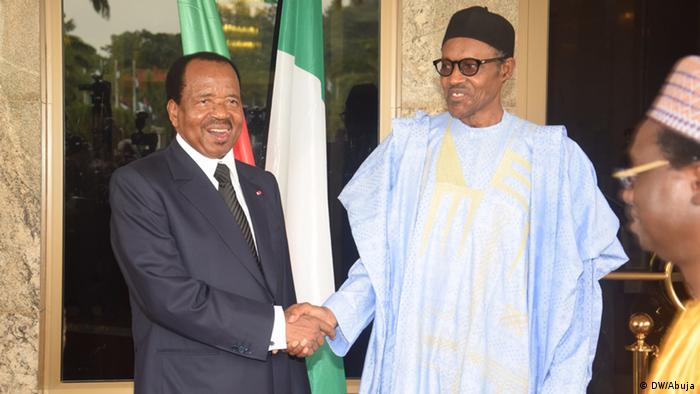
Leaders of Nigeria and Cameroon have signed a series of agreements as they seek to put old disputes aside. Both nations are currently fighting Boko Haram Islamists

Nigerian President Muhammadu (left) greets Cameroonian President Paul Biya (left)
In what appears to be an attempt to restart what were previously cold relations, Nigeria and Cameroon on Wednesday (04.05.16) signed a number of deals aimed at strengthening the security and economy of the Lake Chad Basin nations.
Abuja and Yaounde have long had a dispute over the ownership of the oil-rich Bakassi Peninsula which brought the two nations to the brink of war in 1981. The matter was resolved in 2002 by a decision from the International Court of Justice which handed over possession to Cameroon.
Currently, Nigeria and Cameroon find themselves united against the threat of terrorism. This is one of the main reasons that prompted a two-day visit by Cameroonian President Paul Biya to Abuja.

Tackling Boko Haram
The visit, the first of its kind in over two decades and a half, mostly focused on the Boko Haram insurgency as well as economic cooperation. Biya's last official state visit to Nigeria was in 1991.
Nigerian President Muhammadu and Cameroonian President Paul Biya march past soldiers parade.
The fight against Boko Haram seems to have unified the two leaders
Several agreements on military cooperation and trade were signed by the two leaders. Amongst them is the shared resolve to defeat Boko Haram completely.
"In as much as the security issues are important and we should focus on them, we also understood the need to focus on the economic issues," Biya said at the end of his visit. He said it was important to re-establish the livelihood and revamp the local economies in areas affected by the Boko Haram insurgency.
"We also touched on climate change and its consequences on our region and Africa in general," Biya added.

Military commended
Nigerian President Muhammadu Buhari applauded the contribution by Cameroon and other Lake Chad Basin Commission countries in the fight against Boko Haram.
"On the security aspect, I remain grateful to the Lake Chad Basin Commission, because on my arrival we found some of the efforts made and we have built on it," Buhari said
Soldiers inside a patrol boat in Lake Chad.
Boko Haram has increasingly been making cross-border raids via Lake Chad

The Nigerian leader also mentioned the role played by the Multinational Joint Task Force (MNTJF). The MNTJF was formed as a result of the need by Lake Chad Basin Commission member countries to jointly tackle insecurity, particularly the threat of terrorism. The headquarters of the task joint force is in Chad's capital N'Djamena.
The MNJTF was formed as a result of the need by the LCBC member countries to pool their effort together in a bid to provide a common and coordinated solution to the security challenges in the Lake Chad Basin region, especially the security challenges posed by terrorists in the region and beyond
Read more: https://www.naij.com/452572-nigerian-general-to-head-multi-national-joint-task-force.html
The MNJTF was formed as a result of the need by the LCBC member countries to pool their effort together in a bid to provide a common and coordinated solution to the security challenges in the Lake Chad Basin region, especially the security challenges posed by terrorists in the region and beyond
Read more: https://www.naij.com/452572-nigerian-general-to-head-multi-national-joint-task-force.html
The MNJTF was formed as a result of the need by the LCBC member countries to pool their effort together in a bid to provide a common and coordinated solution to the security challenges in the Lake Chad Basin region, especially the security challenges posed by terrorists in the region and beyond
Read more: https://www.naij.com/452572-nigerian-general-to-head-multi-national-joint-task-force.html
"We have said enough about the performance of both our militaries. We thank you and we thank other members of the Multinational Joint Task Force for occasionally coming in to our own country and securing it for us from Boko Haram terrorists," Buhari said.
Apart from the task of securing their borders, Cameroon and Nigeria also agreed to resume the demarcation of the nearly 1,500 kilometer (932 mile) long contested border.
Musa Ubale in Abuja contributed to this article.
Source: Deutsche Welle

Tuesday, May 3, 2016

Cameroon: US$127 Million to Address Urgent Health Needs of Women and Children in Underserved Northern Regions

PRESS RELEASE

WASHINGTON, May 3, 2016– The World Bank Board of Executive Directors approved today a total of US$127 million to increase the use of and improve the quality of health services in Cameroon, with a focus on reproductive, maternal, newborn, child and adolescent health (RMNCAH) and nutrition services. The funding includes a US$100 million International Development Association (IDA)* credit, and a US$27 million grant from the Global Financing Facility (GFF) Trust Fund.
The project will support the progressive national scale-up of the Performance Based Financing (PBF) program as well as implementation of other high-impact interventions supported by the GFF.  With coverage at 25 percent of the population in 2016, the operation would support a gradual scale-up of an additional 20 percent of the population per year between 2017 and 2020. During the first phase of the extension (2016-2018), the operation will focus on scaling up to the remaining 36 districts in the three northern regions of Cameroon (Far North, North, and Adamawa) to address the urgent and growing needs in those regions.
Women, adolescents and children under 5, as well as displaced and refugee populations affected by insecurity in the region, will benefit from the interventions. The project includes two components that aim to improve performance of the health sector: (i) Strengthening of Health Service Delivery; and (ii) Institutional Strengthening for Improved Health System Performance.
“After six years of experience with PBF in Cameroon, the government has identified PBF as key strategy to improve the efficiency of how resources for the health sector are allocated and used, improve health worker performance through increased motivation and satisfaction, and increase the population’s use of essential health services through an increase in the quality of health services,” says Elisabeth Huybens, World Bank Country Director for Cameroon.
The GFF-supported interventions will have a multi-sectoral approach and improve both health and nutrition outcomes through investing in social protection and education as well as health. Priorities have been identified through the evidence-based and consultative processes now close to completion (and documented in the GFF Investment Case).  In line with the general GFF approach, this includes both RMNCAH interventions, cross-cutting systems interventions, and support to civil registration and vital statistics.
The Global Financing Facility is a multi-stakeholder partnership that supports country-led efforts to improve the health of women, children and adolescents by acting as an innovative financing pathfinder. The GFF Trust Fund is a multi-donor trust fund that leverages additional financing for RMNCAH by linking grant funding to IDA financing.
“Through in-depth analytics and participatory dialogue led by the government, the GFF consultations in Cameroon have resulted in a geographical prioritization of the three northern regions and the East, where health outcomes are significantly worse than rest of the country. The interventions supported by the GFF Investment Case will address the multi-sectoral determinants of health and nutrition, with a particular focus on the economic, education, and demographic challenges in the northern regions of Cameroon, especially for adolescent girls,” says Paul Jacob Robyn, Health Specialist and Task Team Leader for this project.

* The World Bank’s International Development Association (IDA), established in 1960, helps the world’s poorest countries by providing grants and low to zero-interest loans for projects and programs that boost economic growth, reduce poverty, and improve poor people’s lives. IDA is one of the largest sources of assistance for the world’s 77 poorest countries, 39 of which are in Africa. Resources from IDA bring positive change to the 1.3 billion people who live in IDA countries. Since 1960, IDA has supported development work in 112 countries. Annual commitments have averaged about $19 billion over the last three years, with about 50 percent going to Africa.
- World Bank

Friday, April 22, 2016

Buea Homosexual Suspect almost lynched

By Tabie   Bofor
 A homosexual suspect was almost given mob justice on April 20, 2016 when it emerged that he was spotted with another man allegedly in deep romance in the Soppo neighborhood in Buea, Southwest of Cameroon.
    Kamwa Anthony, a film maker ,was reportedly seen by a neighbor with his so-called love partner, a certain man whose name we only got as Mbeng.
   But for the intervention of friends, Kamwa Anthony, born on 20 January 1977, might have been lynched, according to eye witness accounts.
How he  escaped from the mob that had gathered remained a mystery;but unfortunately his partner Mbeng  was seriously  beaten, resulting  in his demise,reports said.   
   Kamwa is now said   to have gone into hiding   for fear of prosecution and or persecution.
Homosexuality is a crime in Cameroon, punishable by Section 347 of the Penal Code in its section 347.
  According to the aforementioned section, “Whoever has sexual relationship with a person of the same sex shall be punished with imprisonment from six months to five years and a fine from 20.000Fcfa to 200.000 Fcfa"
   Although Cameroon is a signatory of the Universal Declaration of Human Rights (UDHR), adopted by the United Nations in 1948 and also a signatory to the United Nations International Covenant on Civil and Political Rights (ICCPR) on June 27, 1984, this central African country is yet to decriminalize homosexuality
  Human rights experts strongly argue that countries that are signatories to rights protection conventions should give protection Lesbian, Gay, Bisexual and Transgender (LGBT) people.
  But Cameroon is not the only country where homosexuality is considered as a crime. In fact over 50 countries are yet to decriminalize it.
It is public knowledge that many homosexuals in the past several years have been prosecuted and jailed in Cameroon.


Tuesday, April 19, 2016

7-Year-Old Boy Hit and Killed by UN Ambassador's Motorcade in Cameroon

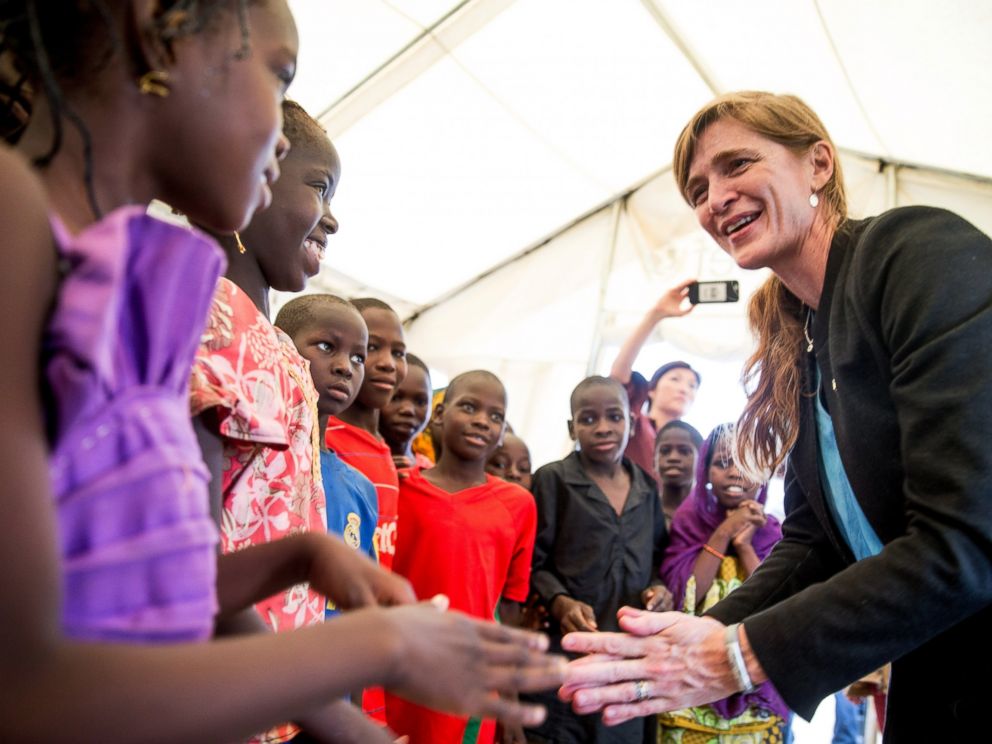
PHOTO: U.S. Ambassador to the United Nations Samantha Power, center, accompanied by Cameroon External Relations Minister Mbella Mbella, right, arrives at Yaounde Nsimalen International Airport in Yaounde, Cameroon on April 17, 2016.
U.S. Ambassador to the United Nations Samantha Power, center, accompanied by Cameroon External Relations Minister Mbella Mbella, right, arrives at Yaounde Nsimalen International Airport in Yaounde, Cameroon on April 17, 2016 /Photo credit:Andrew Harnik/AP

Sunday, April 17, 2016

Issa Tchiroma and The Opposition in Cameroon

When we look at what Time has done to the youthful ambitions of rigour and moralisation, one can only get amused at the casualties that the fading ambitions left on their tracks. One of such casualties is most obviously Issa Tchiroma.

I call him a casualty because I knew him closely in what history will remember as the Coalition for National Reconciliation and Reconstruction (CNRR), composed of a score of them – opposition leaders – who were determined to dislodge Paul Biya in 2004 from Unity Palace. I was the Permanent Secretary of CNRR.

I took him for a serious opposition leader because of the solemnity with which he mumbled the pledge each of them made at each of the regional rallies we held in all ten regional capitals, with the tricolor raised above the assembled leaders, and with each invoking the people and swearing that they would be the last to betray them. In fact, Issa Tchiroma actually wept on the podium in Garoua at the rally he hosted, when the parting speech of Ahidjo was played to the assembled rally attendants from a tape recorder; and he made a rousing, passionate welcome speech. He would later preside over the single-candidate selection meeting of the Coalition that resulted in the rubbishing of those pledges.

To that extent that I knew him, I took him seriously. Based on that, I consider him a casualty. But some may say that if we add the chemical transformation that has converted him from a foe of the regime to a fanatic of the man of November 1982, he may be disqualified as a casualty. No matter!

During the recent cacophony of “calls” and marches in the CPDM, he was seen marching in the East region, either in solidarity or as a surrogate member of the party, urging their hero to hang on. More recently, he has been indulging in the CPDM folly of using numbers, proportions and percentages to define freedoms and rights. And so he has been casting aspersions at opposition leaders that have been sending warning signals to his hero, because they are “minority” leaders!

The story goes that Publius Clodius Pulcher who eventually brought down the corrupt and repressive system of the Roman Republic millennia ago, was a smart, charming and determined person with a keen sense of politics because he was very much in touch with the frustrations of the common people. Even if the ruling elite called him an eccentric and despised him because he was considered not to be a “real man” who could take care of the republic, the same elite eventually stood dazed and helpless as the populist forces he unleashed took control of the Roman Republic the regime had ruled for centuries! This is to remind us that all really important innovations and changes usually start from individuals or tiny minorities of people who use their creative freedom to chart new paths. So Issa Tchiroma, percentages don’t count here!

Talking about percentages and majorities that are so dear to him and his cohorts of the regime, we just need to read Baffour’s Beef (New African Magazine, March 2016) where Baffour Ankomah recalls an article in New American Magazine (November 6, 2000) which states that in 1787, America’s Founding Fathers, “knowing that democracy is a government of men in which the tyranny of the majority rules, wisely created a republic – a government ruled by law, not the people…”

“The ‘tyranny of the majority’ was so anathemic to the Founding Fathers that they managed to write the Declaration of Independence and the Constitution without mentioning the word ‘democracy’ even once in both documents…”!

So, in this folly of percentages, proportions, and majorities of the CPDM and Issa Tchiroma, what is the difference between the dictatorship of a tyrant, a monarch, or a “majority”?

We have heard it said before: It is better to let ten criminals go free than let one innocent person be convicted; when one person suffers injustice, there is no justice. Free public discussion of the stewardship of government through newspapers, publications, rallies, conferences is not supposed to be judged on the basis of numbers, percentages, minorities and majorities.As some people imbued with the democratic spirit would say, anywhere citizens may decide to gather to talk about their government and its policies, or anywhere that a lone eccentric or group of non-conformists gather to voice their opinion, they should be heard, not harassed by a regime, however offensive their opinion may be!

If we go by their efforts to place party cards for free, CPDM militants do not reach even hundreds of thousands of the 20-some million arms we have in Cameroon. And they with Issa Tchiroma have been trying to bully the whole country to adopt their point of view! Even if Issa Tchiroma’s Arithmetic is muddled in this case, he surely has heard about minority rights in a democracy.

Cameroonians are in a fix in a society sharply divided between us and them - torn by mutual suspicion, with the abhorrence of authority from below and a frightening contempt of the people from above. We are trapped in a Kafkaesque society in which everybody takes orders from a superior who takes orders from a superior who takes orders from…  In the confusion, the National Communication Council is on its own side bullying and brutalizing the press to toe an imaginary line, while DOs and SDOs are on their own side arresting and brutalizing the rest of us to stay quiet and watch the macabre actions of the regime!

In this society of La Loi/The Law populated by “authorities” whose answer to every complaint is “I did not make the rules; I am simply applying them…,” Cameroon is the loser, while the selfishness of individuals goes about triumphant. We may regret it for a long, long time!

By  Tazoacha Asongagnyi

Saturday, April 9, 2016

Empowerment: Hon.Lifaka doles out 6.2m Fcfa for tuition of 36 youths in OIC Buea


Hon. Emilia Lifaka congratulates recipients of her scholarship
By Christopher Ambe
Thirty-six (36) underprivileged youths from the Fako West Constituency are currently undergoing two-year training in different trade areas at Cameroon Opportunities Industrialization Center (COIC) Buea, thanks to a scholarship offered them by Hon Emilia Lifaka, Vice Speaker of Cameroon’s National Assembly and MP for the constituency.
     COIC Buea, an affiliate of OIC International with headquarters in Philadelphia, USA, was established in 1986 as a non –profit, community-based skills training program.
    COIC Buea, which started with 60 trainees today has an enrollment of about 1000 trainees.
      The scholarship, baptized Hon.Emilia Lifaka Vocational Training Scholarship, which is at its second edition this year, amounted to 6.2 million FCFa and the money was publicly handed, amid thunderous applause, to the Director of Cameroon OIC, Elinge Marie          Limunga  last Apiril 6, at a ceremony on campus, witnessed by government officials, educationists and traditional authorities.
     Each of the 36 beneficiaries(27 males and  9 females) is receiving marketable skills in one of the following specialties: Hotel catering & Management, Builidng Construction, Plumbing and Electricity, Metal Fabrication, welding and spraying, Information and Communication Tehnology,Textile & Fashion Design ,and Wood work.
The first edition of the Hon. Emilia Lifaka Vocational Training scholarship in 2014 got some 25 underprivileged youth from same constituency as beneficiaries who were trained at Cameroon OIC.
COIC Director Elinge Marie (in glasses) joins dancers 
     Earlier in her welcome speech, the Director of Cameroon OIC,Elinge Marie Limunga, saluted the Hon.Lifaka’s scholarship scheme, noting that  the MP has brought hope to the lives and families of the beneficiaries.
 “The Hon. Lifaka’s scholarship is a huge contribution towards efforts to eradicate poverty and is in line with attaining the Vision 2035, championed by President Paul Biya and which aims at causing Cameroon become an emergent Nation by then.
     Also“the goal of this illustrious mother of goodwill (Hon. Lifaka) is tied to the vision and mission of OIC: that of bringing hope to the hopeless through human resource development”, said the Director, who added that a total of 61 young Cameroonians have benefited this far from the scholarship scheme. “The donor is a lady who does not only give fish, but also teaches people how to fish”
    The director urged other people of goodwill to follow in the footsteps of the donor-MP and “assist the awardees in terms of transportation and sustenance”, areas where some of them still have difficulties, The Recorder learned.
Board Chair Ekeke Njuma praises the donor
     In his address at the ceremony, Cameroon OIC Board chairman, retired Commandant Ekeke Njuma Moses, described Hon Lifaka as a “rare example of those in high positions who have not forgotten their roots and where they come from”
     The Board chair noted: “Nothing erodes the dignity of the human race like poverty, and many of our children are stranded in the corridors of poverty because of unemployment, the lack of marketable skills and the lack of opportunities to acquire such skills.
  “We are extremely thankful that our own icon and venerable elite of the Bakweri Kingdom has for the second successive time decided to sponsor 36 underprivileged youth in the different vocations at Cameroon OIC as a means to liberate them from the dungeons of hardship and give them a brand new opportunity to gain marketable skills so that they can become economically useful in the society and the their families” 
Cross section of VIPS
    According to Retired Commandant Ekeke Njuma Moses, Hon.Lifaka by her gesture is “teaching all of us a valuable lesson in life, namely to remember to give back to our community and to support the less privileged”
     He appealed to other politicians, administrators and business people to add value to the community by supporting sustainable actions that help overcome poverty and misery.
   The Board chair concluded by calling on the 36 beneficiaries to maximize the opportunity accorded them; he equally implored the public to be supportive of Cameroon OIC in whatever form.
    Retired Commandant Ekeke wished that the sky should be the limit to Hon. Lifaka’s political career.
    Speaking on behalf of parents of the scholarship awardees was Mola Veseke Marcus, who lavished praises on the donor-MP for choosing empowerment as her area for assistance.
“We are tired of those politicians who give us rice and beer; we now want our youths to be empowered”
The awardees in group with dignitaries
    A representative of the new beneficiaries was thankful to the Vice Speaker of the National Assembly, noting that the grant would help them fight unemployment and poverty, and make them self-reliant.
    He promised academic excellence and self-discipline during their two-year study.
In response to previous speakers, Hon. Lifaka sang in praise of the Almighty God, noting that she was highly flattered by the kind words addressed to her person.
   She said the 6.2million Fcfa was her part of the contribution for the training of 36 youth, who were selected by chiefs. “My volunteer worked with chiefs of villages to identify the beneficiaries, regardless of political or religious ties”, the Vice-Speaker told the large audience at the ceremony, which was graced by cultural dances and choral singing.
    She recommended hard work and discipline to the beneficiaries. “My children, I want to tell you that the seed you sow today will determine your harvest tomorrow,” she told them.
  Dignitaries who witnessed the ceremony included Humphrey Monono,Registrar of Cameroon GCE Board; Francis Ngundu,Southwest Regional Delegate for Secondary Education, Chief Etina Monono of Great Soppo and Madam Becky Effoe, Director of IVTC Buea.


Sunday, April 3, 2016

RECOGNIZING THE HIDDEN GREATNESS WOMEN POSSESS

By Tem Martin*

Dear reader, this may not come during the women’s day hype but it is meant to help you adjust your view about the woman. It is not a woman’s emancipation issue. It is a truth and reality analysis.

The Bible says women are weaker vessels and that is true. Another side of the story is that while a man was made from the earth, the woman was made from a bone – an already refined material. So a woman may be weak physically but possess areas of strength which will baffle any man. Many people are unaware of the fact that God gave an unusual dose of power and a diversity of abilities to women.

While in secondary school and even in the university, I started having an idea of these hidden potentials women have that need to be exhumed and exposed to the world for appreciation. Some of these girls topped the class by taking the first three places before a boy showed up.

SEE THEM IN THE HOME
When I got married and my wife became pregnant, I saw her go through the inconveniences of the pregnancy and I was also present in the labour room and saw what she went through before I became the father of Treasure-Noela. That was not all. Despite all what she went through with the pregnancy, labour and delivery, when the baby finally came, there were several sleepless nights from the crying baby. Guess who was mostly in charge – my wife: breastfeeding the child, babying her to sleep, changing the child’s napkins, etc. I had to learn how to change the child’s diapers to lesson her work at night.

A time came for discovery! My wife had to be away during the day for a couple of days. I had to take care of the child. By this time, she was creeping and a very active type. To keep track of her just in the house so she does not destroy something or hurt herself was already much work for me. To prepare her food, feed her and bathe her was another. I had to also try to prepare something for the family, this I must tell you was already getting out of control. I like reading. I had to try to read a few paragraphs from my selected book; this I must say was not a big success.
By the end of the day, I was exasperated. Just one baby, not two, just one day not two. I started thinking: “this is what my wife does daily without even blowing a trumpet.

A MAN MAY NEED TO GIVE IT A TRY
A typical man who has never spent a day with the child may come back and shout or in the worst cases, some primitive, uncultured men may even beat up their wives for not having cleaned the house, prepared food and the like. But if a man may sacrifice just a day or two and I recommend that men do it, whenever they come back and want to shout at their wives, just thinking about the work of taking care of the child, their tongues will stick to the roof of their mouths.

Lately one of my pastor friends told me that his wife left him with their over 6-month old baby to go to a night vigil, as they were in the night vigil in church, he also observed a night vigil with the crying baby at home. When his wife came back, he says he warned his wife more in zest than in earnest never to try it again because it was not easy for him.

Men are strong and can handle tasks singly with amazing success but when it comes to handling several tasks at the same time, a woman will beat a man at this game aller et retour.

A woman has been said to have the sixth sense. When a woman keeps refusing something, it pays to listen to her. A very logical man will ask “what really is your reason?” Don’t be surprised to hear her say “I don’t know, but I just have this feeling that you should not go or you should not do this thing”. It is not weakness but wisdom for the man to listen.

A BUNDLE OF EMOTIONAL POTENTIAL
A woman is a bundle of emotional potential. Going through the day with the nagging of children, characterized by crying, reporting each other, request for food, etc. by the evening the woman is already so tired but guess what, when the man comes home in the evening, he needs his own food, and interestingly enough, at night he still needs “more food” and most of the time the woman will just yield. Many of them do this without complaining. It is hidden in them.

RESISTANCE AND RESILIENCE
Several times when the family goes to the farm or comes back from office and come back say at 6p.m, the man usually bathes, curls up with a newspaper or sits in front of the TV or reads a book while the woman passes into the kitchen almost without questioning.
When any man takes a sincere look on the several roles the woman plays and how she manages them well, if you have been used to telling the truth and appreciating what is truly good, you will not come short of openly praising the woman.

A woman is a store house of potentials, greatness and power, until you take time to explore her world, you may never appreciate this creature of God called woman. Woman! Yes, you can! I salute you!
By Tem Martin

*Tem Martin is an author of over 20 books.To get in touch with him for his books or for speaking engagements, you can use (237) 675647979 or 694818336 Email: temmartin1@yahoo.com

Saturday, April 2, 2016

Cameroon:Monique Koumate and CPDM Politics of Numbers

By Tazoacha Asonganyi in Yaounde

Another March 24 has come and gone, and added a year to the age of the CPDM. And once again, the party spent the day in the folly of talking about one man, and counting “his” achievements. It continued to indulge in a simplification of politics that offers no real measuring rod of success and failure. Indeed, it continued to indulge in a type of mob action that betrays intellectual weakness, and a feeble mindedness that touts around uncertain means of achieving equally uncertain objective.

The party again indulged in the counting of their “greater achievements,” one by one, in the certainty that even if the rest of us can argue about a lot of things, we cannot argue about arithmetic. In this, they forget that quality is much more difficult to handle than quantity; that the exercise of judgment is a higher function than the ability to count and calculate.

Quantitative differences can be more easily grasped and certainly more easily defined than qualitative differences. The materialist philosophy on which CPDM arithmetic is based makes it liable to overlook the most important pre-condition that make all the difference between quantity and quality.

The fate of Monique Koumate in Laquintinie Hospital in Douala, and more recently the quintuplets in the Central Hospital in Yaounde tell us that what we see as a modern hospital, a factory, a seaport – a “greater achievement”! – are just the tips (the hardware) of complex infrastructures that perform the duties they are meant to perform. What we cannot see is the software – the discipline, the intellectual achievements behind the planning, the organization and the functioning of the structures; the great inputs that are the pre-condition for making what we see either an empty shell or a vibrant structure.

So we see only the tip of the structure; the greater part of the structure is invisible. The counting game the CPDM indulges in is usually based on what they become conscious of – the visible; and they easily overlook the invisible because they consider what they see as green pasture offered to some fanatical supporter of their politics. Yet it is the invisible things that make the visible possible, keep it going, and prevent tragedies like the ones we are living in our hospitals and in many other structures in our society.

With the hospital tragedies, many people are talking about the quality of training in CUSS – a Faculty I have taught in for the last 30-some years - as if the problem is at that level. Education cannot help us as long as it is detached from metaphysics - our fundamental convictions. Education is something more than mere training; something more than mere knowledge of facts. It is a process of giving ideas that would make the world more intelligible to the recipients. It is giving moral instructions that fill the inner spiritual space with some higher motivation of love, goodness, and truth. Otherwise, the space is filled with lower stuff like small, mean, and calculating attitudes to life which are rationalized in economic calculus centered on personal gains.

Emmanuel M.P. Edeh (Igbo Metaphysics) says that Africa had a Man-God-World conceptual scheme or relationship. Its culture was (is?) based on understanding and interpreting this scheme; on the influence of this relationship on life and existence. This confirms Tatah Mbuy’s (The Faith of our Ancestors) statement that African Traditional Religion (ATR) is the core of African culture, and constitutes the grammar of existence for Africans. It is the location at which the genuine African and his life-situation are encountered. This also confirms John S. Mbiti’s statement that Africa had no written texts as such; their religion was written in the history, the hearts and experiences of the people.

It is this religiosity that helped our forebears to appreciate metaphysical truths. It is usually said that Europe that sent forth the early Europeans that came to Africa, was shaped by education, organization and discipline that radiated from its metaphysics and ethics which brought forth its science and technology. Those early Europeans that came face to face with our culture came armed with the Judeo-Christian religion which was the basis of the metaphysics and ethics on which their societies had been built, and which was virtually congruent with our religious beliefs, in spite of its total exclusion of the black person from the imagery that the religion left in our minds.

In addition, they came with a “new” metaphysics enunciated in Darwin’s theory of evolution, competition, natural selection and the survival of the fittest; Marx’s concept of class struggle; the idea of relativism enunciated by Sophists that denied all absolutes; and the idea of positivism that sought to extend the positive sciences to social facts and so denied the existence of God and repudiated metaphysics.

It is mainly these “new” metaphysical ideas that were left with us and have congealed in our consciences. By the time of “decolonization” and “independence”, we were full of wrong ways of thinking and living, which only bred/breed alienation. We were left in great confusion as to what our convictions are. This is why the repeatedly stated idea of an education system based on “African culture” – African metaphysics - is attractive to us, but our hearts are somewhere else. We want to develop, to achieve happiness by neglecting our true spiritual realm; we want to satisfy the body, neglecting the deepest feelings of our soul. And so we hear often from those who govern us – from Africans with religion as the core of (their) culture, and the grammar of (their) existence – proclaiming: candidates should have so many GCE O/A Levels, except “religion”!  With nothing to take the place of “religion”, the emotional part of our nature is enfeebled and our moral character is injured.

The key factor of all development comes out of the mind of humans. Development is not about visible structures that are counted and boastfully proclaimed as “greater achievements”; it is about people, their education, organization and discipline. The emergence of a country is secondary to the emergence of its people; just as the development of a country is secondary to the development of its people. People emerge when they themselves are the owners and producers of what they see around them: the ports, the roads, the stadiums, the industries. Society emerges when its leadership is reconciled with democracy; clever formulae that promote leadership without democracy cannot work because they lose the very quality of human nature and human life. Power that excludes its opposite - the opposition - can achieve nothing concrete.

As is usually said, we should always let Athena spring out of the head of Zeus. The cacophony in the implementation of “emergency plans” and “greater achievement” projects, produce countable structures that are created for us, without us; these cannot compensate for arrangements that insult our self-respect and impair our freedom.

The feeble responses of the CPDM regime to the tragedies in Laquintinie Hospital and the Central Hospital are a result of our living with a kind of metaphysical disease. The tragedies are a reminder that the primary cause of extreme poverty is immaterial; it lies in certain metaphysical deficiencies; in deficiencies in education, organization and discipline.

Even if ‘old dogs cannot learn new tricks’ as the saying goes, ‘new dogs’ grow up all the time; they will be well advised to learn what ‘old dogs’ are unable to learn – that we need to integrate African metaphysics as the foundation of the education we get. Only this can make our education useful to our daily existence as a people with dignity, and prevent tragegies of disorganisation and indiscipline that bring us so much shame.


SEARCH THIS SITE